Dirty (2025)
En Dirty pongo en común dos líneas de trabajo:
por un lado, mi práctica de escritura, presente desde hace años en mis piezas,
y por otro, mi práctica reciente con la arcilla (cerámica).
Nada más tocar el barro con mis manos, se generó una relación con la materia muy particular.
Es una relación totalmente física.
Al tocarlo vas induciendo su comportamiento, es como si hablases con el barro. Y el barro siempre te contesta. Cualquier cosa que le propones obtiene una respuesta, muchas veces inesperada.
Se crea una especie de diálogo entre un pedazo de barro y tú, un diálogo íntimo que te lleva a una escucha, una atención y una concentración muy específicas.
Esta experiencia me ha llevado a pensar el hacer como una forma de escucha,
y el contacto como una forma de conocimiento.
Del diálogo con la materia (arcilla) surgen dos preguntas que atraviesan toda la obra:
¿qué escucho cuando toco?
¿qué toco cuando escucho?
A partir de ahí, la pieza se despliega en tres situaciones que activan diferentes modos de percepción, atención y participación.
Primera situación: ver / tocar con la mirada
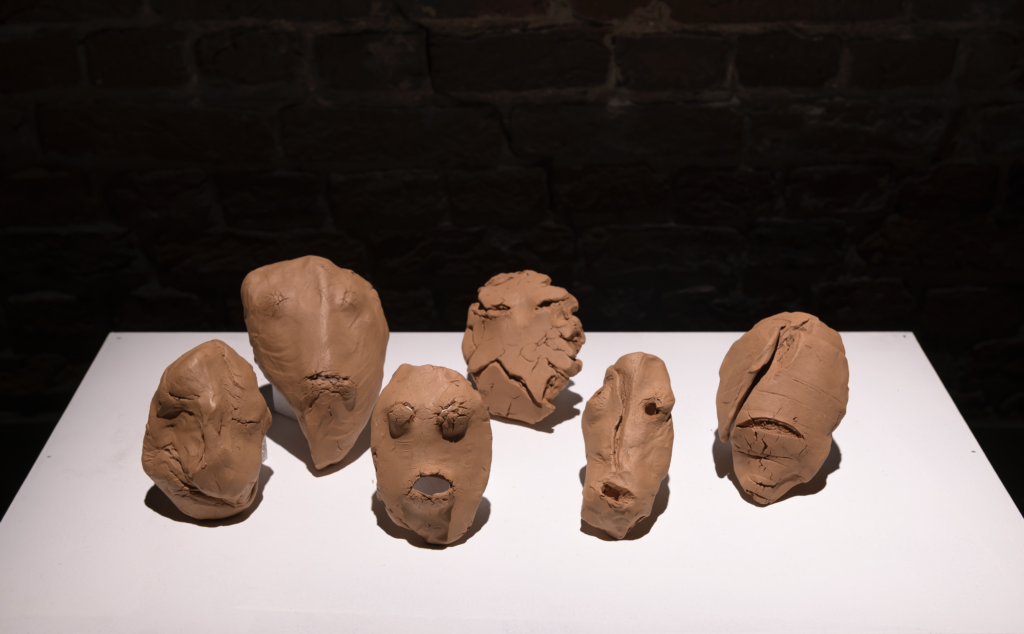
En la primera parte, el público se encuentra con una serie de caras de cerámica realizadas durante diferentes residencias.
Estas caras aparecieron al descubrir que, al amasar el barro de una determinada manera, surgían formas que evocaban rostros con formas y expresiones muy diversas.
A partir de ese hallazgo, la investigación se desplaza hacia la percepción:
¿qué tocamos cuando vemos?
¿y qué vemos cuando tocamos?
Las piezas habitan un espacio ambiguo entre la pre-escultura y el emoticono,
entre lo mínimo necesario para producir una expresión y el exceso de lo grotesco.
Lo grotesco funciona aquí como una fuerza de desbordamiento,
capaz de poner en crisis nuestras ideas de rostro, de humanidad y de belleza.
El espectador recorre libremente este espacio, sin un orden prefijado,
construyendo su propia relación con esas presencias.
Segunda situación: escuchar / ser tocado por el lenguaje
En la segunda parte, la experiencia se desplaza hacia la escucha.
El público es invitado a sentarse y a habitar un espacio sonoro y textual donde el lenguaje se percibe como materia que toca.
El texto, a través de la oralidad, explora el lenguaje como tacto y su capacidad de tocarnos.
¿Hasta cuánto puede darse de sí una vida?
Los textos construyen una metáfora insistente y perturbadora: la ropa que se da de sí. Una tela que se estira, se deforma, pierde su forma original sin que sepamos exactamente cuándo ocurrió el cambio. No hay un instante preciso en el que algo deja de ajustarnos; el deterioro es progresivo, casi imperceptible. La pregunta que recorre el texto no es solo material —¿cuándo se agranda la ropa?— sino existencial y política: ¿cuándo empezamos a menguar nosotros?
La elasticidad se convierte en categoría crítica. La ropa, el país, los cuerpos: todo se estira. El país “dado de sí” es una imagen poderosa de la crisis normalizada. Una bandera hecha de tela vencida no representa únicamente un símbolo debilitado, sino una comunidad que ha sido forzada a expandirse más allá de sus límites soportables. Se vive en un país estirado cuando el miedo es cotidiano, cuando las treguas son ficción, cuando la violencia se vuelve paisaje.
El texto señala también la anestesia colectiva: “como todo es posible, nada es posible”. La repetición de la catástrofe vacía la capacidad de sorpresa. Solo importa cuando “te toca”. La empatía se reduce al impacto directo. El desgaste no solo es material o corporal: es moral y afectivo.
La sección sobre el ahogamiento radicaliza la metáfora del límite. El cuerpo que se asfixia es el cuerpo que ha excedido su capacidad de resistencia. El exceso de agua, la falta de oxígeno, el corazón errático: el sistema colapsa. El “punto de quiebre” no es una abstracción; es fisiología. Es el momento en que ya no se puede más. Así también el país, la comunidad, la carne social pueden llegar a ese umbral. El problema es que muchas veces el colapso ocurre después de haber normalizado durante años la falta de aire.
La migración aparece como consecuencia de ese ahogo colectivo. “Prohibido pasar” es la frase que condensa la contradicción: se expulsa y se bloquea al mismo tiempo. El desplazamiento no es elección sino supervivencia. Sin embargo, quedarse también puede ser una forma de resistencia. El texto no ofrece soluciones; solo evidencia el desgarro entre partir o morir.
Y, sin embargo, en medio del desgaste, emerge otra potencia: el cuerpo como posibilidad. Frente a los cuerpos demolidos, aparecen cuerpos que cantan, que abrazan, que se desean. El erotismo no es aquí un simple detalle sensual, sino un gesto político. El contacto, el placer compartido, la intimidad sin interferencias son actos de afirmación vital. Allí donde el sistema asfixia, el cuerpo que goza recupera oxígeno.
El contraste es deliberado: cuerpos zombies que consumen todo frente a cuerpos que se desean y se cuidan. La pregunta “¿qué puede un cuerpo?” atraviesa el texto como una interrogación filosófica central. Puede agotarse, puede resistir, puede morir. Pero también puede amar, decidir, construir y liberar.
En última instancia, el texto plantea que el verdadero peligro no es solo el desgaste, sino la incapacidad de reconocerlo a tiempo. La ropa se da de sí gradualmente; el país también; el cuerpo también. El problema no es la transformación —que es inevitable— sino la naturalización del deterioro y la violencia.
La obra deja abierta una pregunta inquietante: ¿estamos menguando o simplemente nos estamos adaptando a una forma deformada de existir? Y si todo se estira, ¿sabremos identificar el momento justo antes del desgarro?
Porque todo cuerpo, toda comunidad, toda vida tiene un límite. La cuestión es si sabremos reconocerlo antes de que falte el aire.
Los sonidos por otro lado —generados y transformados en directo— no funcionan como acompañamiento, sino como materia en sí misma. Han sido concebidos como texturas acústicas que se despliegan en el espacio y atraviesan el cuerpo del espectador.
Más que construir una composición cerrada, el trabajo sonoro propone un ecosistema en transformación constante: capas que aparecen, se dilatan, se filtran o se erosionan. La escucha se vuelve entonces una forma de contacto, no frontal ni dirigida, sino envolvente y porosa.
La acústica no se limita a emitir sonido, sino que modula la percepción del espacio. Las vibraciones, las resonancias y las frecuencias activan distintas zonas del cuerpo, generando una experiencia que oscila entre lo audible y lo táctil. En algunos momentos el sonido se percibe casi como una presión o una caricia; en otros, como un flujo que sostiene o desestabiliza.
Todos los sonidos provienen del agua: goteos, fricciones, vibraciones. Son transformados en tiempo real, amplificando sus cualidades materiales hasta convertirlos en paisajes abstractos. Así como el cuerpo humano no existiría sin agua, ni el barro sin humedad, el espacio sonoro se construye desde esa misma condición líquida: mutable, adaptable, imposible de fijar.
Hidratarse con el sonido aparece así como una metáfora, pero también como una experiencia concreta: una inmersión en un medio que no se puede agarrar, pero que sin embargo nos atraviesa y nos sostiene.
Tercera situación: tocar / producir experiencia
En la tercera situación, el público es invitado a manipular arcilla.
Aquí la experiencia se vuelve directamente física.
El espectador pasa a ser participante y el contacto se convierte en acción.
El gesto de tocar reactiva las preguntas iniciales desde el cuerpo:
escuchar con las manos, pensar a través del tacto, responder a la materia y dejarse afectar por ella.
Dirty se llama así porque trabajar con el barro implica necesariamente ensuciarse.
No hay distancia limpia posible. Ensuciarse no es un accidente, sino una condición de la experiencia.
La obra propone entrar sin prisa, recorrer, escuchar, tocar, y dejar que algo ocurra en ese intercambio. No hay una única manera de atravesarla. Cada recorrido es distinto, como cada diálogo con el barro.
Dirty
Concepto y dirección: Juan Domínguez
Acompañamiento artístico: Julia Rodríguez
Diseño de sonido: Eric Desjeux.
Una producción de Juan Domínguez con el apoyo de La Casa Encendida Madrid, La Gineta Monachil-Granada, Festival Transversales Mérida-México, Teatro Calderón de Valladolid y GC De Markten, Pianofabriek, Kaaitheater Bruselas en el marco de Europalia 2025.
—————————–
In Dirty I bring together two lines of work:
on the one hand, my writing practice, present for years in my pieces,
and on the other, my recent practice with clay (ceramics).
As soon as I touched the clay with my hands, a very particular relationship with the material was generated.
It is a totally physical relationship.
By touching it, you begin to induce its behavior; it is as if you were speaking with the clay. And the clay always answers you. Anything you propose to it produces a response, often unexpected. A kind of dialogue is created between a piece of clay and yourself, an intimate dialogue that leads you to a very specific kind of listening, attention, and concentration. This experience has led me to think of making as a form of listening,
and contact as a form of knowledge.
From this dialogue with the material (clay), two questions arise that run through the entire work:
what do I hear when I touch?
what do I touch when I hear?
From there, the piece unfolds in three situations that activate different modes of perception, attention, and participation.
First situation: seeing / touching with the gaze
In the first part, the audience encounters a series of ceramic faces made during different residencies.
These faces appeared when I discovered that, by kneading the clay in a certain way, forms would emerge that evoked faces with very diverse shapes and expressions.
From that finding, the research shifts toward perception:
what do we touch when we see?
and what do we see when we touch?
The pieces inhabit an ambiguous space between pre-sculpture and the emoticon,
between the minimum necessary to produce an expression and the excess of the grotesque.
The grotesque functions here as a force of overflow,
capable of putting into crisis our ideas of the face, of humanity, and of beauty.
The viewer moves freely through this space, without a predefined order,
constructing their own relationship with these presences.
Second situation: listening / being touched by language
In the second part, the experience shifts toward listening.
The audience is invited to sit and inhabit a sonic and textual space where language is perceived as a material that touches.
The text, through orality, explores language as touch and its capacity to touch us.
How far can a life stretch?
The texts construct an insistent and unsettling metaphor: clothes that stretch out. A fabric that lengthens, deforms, loses its original shape without us knowing exactly when the change occurred. There is no precise moment when something stops fitting us; the deterioration is progressive, almost imperceptible. The question that runs through the text is not only material —when do clothes get bigger?— but existential and political: when do we begin to shrink?
Elasticity becomes a critical category. Clothes, the country, bodies: everything stretches. The “stretched-out” country is a powerful image of normalized crisis. A flag made of worn-out fabric does not only represent a weakened symbol, but a community that has been forced to expand beyond its bearable limits. One lives in a stretched country when fear is everyday, when truces are fiction, when violence becomes landscape.
The text also points to collective anesthesia: “when everything is possible, nothing is possible.” The repetition of catastrophe empties the capacity for surprise. It only matters when “it touches you.” Empathy is reduced to direct impact. The wear is not only material or bodily: it is moral and affective.
The section on drowning radicalizes the metaphor of the limit. The body that suffocates is the body that has exceeded its capacity for resistance. Excess water, lack of oxygen, an erratic heart: the system collapses. The “breaking point” is not an abstraction; it is physiology. It is the moment when one simply cannot go on. In the same way, the country, the community, the social body can reach that threshold. The problem is that collapse often comes after years of normalizing the lack of air.
Migration appears as a consequence of this collective suffocation. “No entry” is the phrase that condenses the contradiction: expulsion and blockage at the same time. Displacement is not a choice but survival. And yet, staying can also be a form of resistance. The text offers no solutions; it only reveals the tear between leaving or dying.
And yet, in the midst of wear, another potential emerges: the body as possibility. Against demolished bodies, there appear bodies that sing, that embrace, that desire each other. Eroticism here is not a mere sensual detail, but a political gesture. Contact, shared pleasure, intimacy without interference are acts of vital affirmation. Where the system suffocates, the body that enjoys recovers oxygen.
The contrast is deliberate: zombie bodies that consume everything versus bodies that desire and care for each other. The question “what can a body do?” runs through the text as a central philosophical inquiry. It can be exhausted, it can resist, it can die. But it can also love, decide, build, and liberate.
Ultimately, the text suggests that the real danger is not only wear, but the inability to recognize it in time. Clothes stretch gradually; so does the country; so does the body. The problem is not transformation —which is inevitable— but the naturalization of deterioration and violence.
The work leaves open an unsettling question: are we shrinking, or are we simply adapting to a deformed way of existing? And if everything stretches, will we know how to identify the moment just before the tear?
Because every body, every community, every life has a limit. The question is whether we will be able to recognize it before the air runs out.
The sounds, on the other hand —generated and transformed live— do not function as accompaniment, but as matter in themselves. They have been conceived as acoustic textures that unfold in space and pass through the spectator’s body.
Rather than constructing a closed composition, the sound work proposes an ecosystem in constant transformation: layers that appear, expand, filter, or erode. Listening then becomes a form of contact, not frontal or directed, but enveloping and porous.
Acoustics do not merely emit sound, but modulate the perception of space. Vibrations, resonances, and frequencies activate different zones of the body, generating an experience that oscillates between the audible and the tactile. At times, sound is perceived almost as pressure or a caress; at others, as a flow that sustains or destabilizes.
All sounds come from water: drips, frictions, vibrations. They are transformed in real time, amplifying their material qualities until they become abstract landscapes. Just as the human body would not exist without water, nor clay without moisture, the sound space is built from that same liquid condition: mutable, adaptable, impossible to fix.
Hydrating oneself with sound thus appears as a metaphor, but also as a concrete experience: an immersion in a medium that cannot be grasped, yet nonetheless passes through us and sustains us.
Third situation: touching / producing experience
In the third situation, the audience is invited to manipulate clay.
Here the experience becomes directly physical.
The spectator becomes a participant, and contact becomes action.
The gesture of touching reactivates the initial questions from the body:
listening with the hands, thinking through touch, responding to the material and allowing oneself to be affected by it.
Dirty is called this because working with clay necessarily involves getting dirty.
There is no possible clean distance. Getting dirty is not an accident, but a condition of the experience.
The work proposes entering without haste, moving through, listening, touching, and allowing something to happen in that exchange. There is no single way to experience it. Each path is different, like each dialogue with clay.
Dirty
Concept and direction Juan Domínguez
Artistic accompaniment Julia Rodríguez
Sound design Eric Desjeux. A production by Juan Domínguez with the support of La Casa Encendida Madrid-Spain, La Gineta Granada-Spain, Festival Transversales Merida-Mexico, Teatro Calderón Valladolid-Spain and GC De Markten, Pianofabriek, Kaaitheater Brussels-Belgium within the frame of Europalia 2025.


Credit photos : Pierre Vanneste